WASHINGTON – When IndyCar takes over the National Mall in August – in the heart of America’s most restricted no-fly zone – the FAA will allow drone flights to capture the scene.
Homeland security experts aren’t confident the agency can make that happen safely.
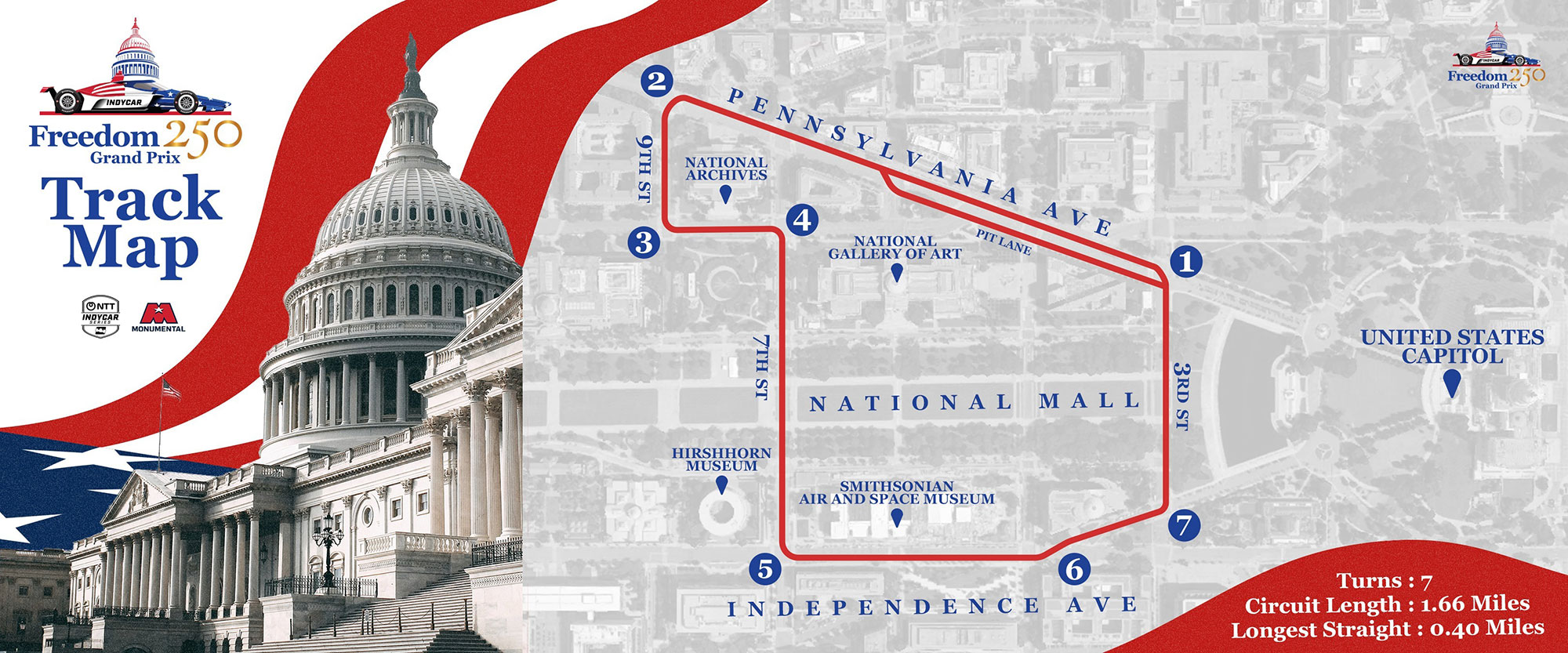
The 1.7-mile course for the Freedom 250 Grand Prix on Aug. 22 and 23 will bring speeding cars within 1,400 feet of the Capitol, with a tight turn at FBI headquarters on Pennsylvania Avenue and a long stretch alongside the Department of Justice.
“Drones in the wrong hands with the wrong intent can provide a major threat to critical infrastructure, to people, purely because of the capability that they provide from the air if not regulated, if not tracked,” said retired Coast Guard Vice Adm. Peter Gautier, a senior fellow at the Atlantic Council who led disaster preparedness at the National Security Council earlier in his career.
President Donald Trump authorized the drone flights in an executive order in January that added the race to the list of the nation’s 250th birthday celebrations.
“These beautiful cars are going to make freedom roar,” Trump said Monday at a White House ceremony showcasing the race, predicting speeds up to 190 mph on the Pennsylvania Ave. straightaway.
The FAA hasn’t said how many drones it will allow, what restrictions will be in place or how those would be enforced in real time.
Nor has it backed away from the plan despite an alleged plot to attack the UFC mixed martial arts event on June 14 at the White House using drones armed with explosives. The FBI arrested seven plotters. Authorities said they planned to force an evacuation, allowing snipers to shoot top government officials in the chaos.
Through July 4, over 600 drones have been seized for entering restricted airspace in FIFA World Cup host cities across the U.S., according to the FBI.
Gautier, the former No. 2 officer at the Coast Guard, said the Ukraine-Russia war and the U.S.-Israel war with Iran have made clear that drones can be powerful weapons.
The U.S. military and federal agencies, including the FAA and the Department of Homeland Security, have made strides on counter-drone defenses. But they don’t yet have enough capability to know what’s in the air, and they have not deployed sufficient countermeasures, he said.
“We’re not as prepared nationally as we need to be,” he said.
After the Sept. 11, 2001, attacks, the FAA imposed a 17-mile no-fly zone around Ronald Reagan Washington National Airport. Recreational flights are banned, and even government agencies must go through a lengthy approval process.
The airspace over the National Mall is even more tightly controlled.
Under a 1938 presidential order, a prohibited flight area stretches from the Lincoln Memorial to the Capitol and includes the White House, as well as much of downtown Washington, up to 18,000 feet. The vice president’s residence at the Naval Observatory was added in 1950.

Only aircraft supporting the Secret Service, Office of the President and select government agencies can receive approval to fly in that zone. Typically, the only aircraft anywhere near the White House is Marine One, plus escort and spotter helicopters.
In 2015, a 2-foot diameter quadcopter crashed into a tree on the South Lawn of the White House, raising alarms about the rise of threats too small to detect by radar, let alone stop.
In March, unidentified drones were spotted over Fort McNair, the Army base near downtown D.C. that Defense Secretary Pete Hegseth and Secretary of State Marco Rubio call home.
Rick Breitenfeldt, an FAA spokesperson, confirmed the agency would issue waivers for drones at the IndyCar race. He declined to say how many permits would be offered or what precautions will be in place to ensure those are the only drones in the air, and to prevent the devices from being used in an attack or from straying beyond approved zones.
Official guidance will be released closer to the event, he said. According to the National Business Aviation Association, rules for similar events are generally laid out as far as two weeks in advance.
Apart from the FBI and DOJ, the Grand Prix route passes the Canadian embassy, the Smithsonian’s National Air and Space Museum, National Gallery of Art and National Archives. Cars will come within 3,400 feet of the White House.
Gautier said the Sept. 11 attacks “made brutally aware the vulnerability that we have in terms of our buildings and our critical infrastructure to aviation attacks.”
Apart from the two planes that toppled the World Trade Center in New York, a jet hijacked shortly after takeoff from Dulles International Airport, 22 miles west of the White House, crashed into the Pentagon.
“In terms of the D.C. airspace, in terms of an FAA waiver for a particular event, it’s really a matter of, ‘Is it legitimate use, do I know who’s flying and whether that’s authorized or not?’” Gautier said.
He didn’t anticipate security issues, but only so long as the FAA could answer those questions about the drones at the race.
Greg James, the vice president of business development at airspace management software company DroneUp, agreed that the FAA has made progress on airspace security but said a gap remains in real-time awareness of what’s happening in the skies.
He said airspace supervisors lack the ability to fully identify drones. Nor can they determine quickly who is controlling them and from where, or ensure they adhere to pre-approved flight plans. That makes it challenging to monitor airspace at the race.
“Allowing a lot of recreational pilots to fly in sensitive airspace, that’s where you really need to level up as far as coordination and awareness and trust with what’s there,” James said.
Katie Inman, who worked on drone regulation at the FAA and also served as the principal attorney at the National Transportation Safety Board, said she trusts the safeguards in place.
Authorities have the capability to jam signals or use other technology to disable law-breaking drones, she said, and strikes of some kind could also be on the table.
“They will not allow any unsafe operations, and they will quickly mitigate, deter and take care of any security issues,” she said.
In February, the U.S. military mistakenly shot down a U.S. Customs and Border Protection drone near El Paso using an unmanned anti-drone laser system.
The Defense Department, CBP and FAA issued a joint statement saying the incident involved “a seemingly threatening unmanned aerial system operating within military airspace.” Two weeks earlier, Mexican cartel drone incursion prompted the FAA to announce – and then quickly rescind – a 10-day closure of the El Paso airport.
Inman said the Grand Prix waivers are a sign that the FAA is open to innovation.
“If you’ve got a credible application and a good case with good risk mitigations or very strict limitations on your proposed operation, you’ve been vetted appropriately, they’re not going to be unreasonable,” she said.